
How to Spot Scam Casinos Before You Deposit
May 18, 2026
Guide
Spotting scam casinos the complete guide
Scam casinos are one of the biggest risks in online gambling.
Some are obvious. They use fake licenses, unrealistic bonuses, copied reviews and unclear ownership details. Others look professional, offer popular games, accept familiar payment methods and appear trustworthy at first glance.
That is why players should never judge a casino only by design, bonus size or advertising.
A safe online casino should be transparent about who operates it, where it is licensed, how withdrawals work, which rules apply to bonuses, and how players can get help if something goes wrong.
A scam casino, or a high-risk casino, often does the opposite. It hides important information, delays withdrawals, changes terms without warning, refuses verification documents, or makes it almost impossible for players to recover legitimate winnings.
At Casino.help, we treat scam prevention as a core player safety topic because the damage can be serious. Players may lose deposits, winnings, personal documents and payment information if they sign up at unsafe casino sites.

Key Takeaways
- A scam casino is an online casino that misleads players, hides ownership, uses fake or weak licensing, refuses legitimate withdrawals, manipulates terms, or operates without meaningful player protection.
- The biggest warning signs include fake license claims, unclear ownership, unrealistic bonuses, delayed withdrawals, copied content, poor complaint history and vague terms.
- A casino does not need to be completely fake to be dangerous. A real casino can still be high-risk if it has unfair payment rules, weak licensing, aggressive bonus terms or many unresolved player complaints.
- Always verify the license, company name, withdrawal rules, bonus terms and complaint history before depositing.
- Do not use a VPN, fake details, someone else’s payment method or multiple accounts. These can give unsafe casinos an excuse to void winnings.
- If a casino refuses to pay, collect evidence immediately: screenshots, transaction IDs, chat transcripts, emails, bonus terms and account history.
What Is a Scam Casino?
A scam casino is an online gambling site that uses dishonest, misleading or abusive practices against players.
Warning Signs
Watch for these warning signs before continuing.
- Operating without a valid license
- Using fake regulator logos
- Hiding ownership information
- Refusing legitimate withdrawals
- Creating impossible bonus terms
- Changing rules after players win
- Blocking accounts without clear reason
- Ignoring player complaints
- Running copied or fake casino reviews
- Advertising bonuses that cannot realistically be withdrawn
- Requesting excessive personal documents without explanation
- Using misleading payment or crypto claims
Some scam casinos are fully fraudulent. They are built mainly to collect deposits and personal data.
Others are not outright fake but still operate in a way that puts players at risk. These casinos may have a license, games and working payment systems, but they use vague rules, slow payouts, weak support or aggressive bonus terms to reduce withdrawals.
For players, the practical question is not only “Is this casino technically real?”
The better question is:
Can I trust this casino with my money, documents and winnings?
Scam Casino vs High-Risk Casino
Not every bad casino is a scam casino.
It helps to separate three categories.
Legitimate Casino
A legitimate casino usually has:
- Clear licensing information
- Verifiable company ownership
- Published withdrawal rules
- Fair bonus terms
- Responsible gambling tools
- Real customer support
- Transparent KYC process
- Reasonable complaint history
A legitimate casino can still have problems, but players have clearer protection and dispute options.
High-Risk Casino
A high-risk casino may not be completely fraudulent, but it has warning signs.
- Weak offshore license
- Slow withdrawals
- Poor support
- Confusing bonus terms
- Vague KYC rules
- Many unresolved complaints
- Limited responsible gambling tools
- Country restrictions that are not clearly explained
High-risk casinos require caution. Some players may get paid, while others may face serious problems.
Scam Casino
A scam casino shows severe warning signs such as:
- Fake license
- No company name
- No clear terms
- Refusal to pay legitimate winnings
- Fake support
- Copied content
- Manipulated reviews
- Suspicious payment requests
- Disappearing accounts
- No complaint process
Players should avoid these sites completely.
Why Scam Casinos Are Dangerous
Scam casinos can harm players in several ways.
The most obvious risk is financial loss. You may deposit money, win, request a withdrawal and never receive payment.
But the risks go further.
Unsafe casinos may collect:
- Name
- Address
- Phone number
- Date of birth
- ID documents
- Bank details
- Crypto wallet information
- Card details
- Proof of address
- Selfie verification images
That information can be sensitive. If a casino is not trustworthy, players should think carefully before uploading identity documents.
Scam casinos may also pressure players with unrealistic bonuses, fake urgency, misleading VIP promises or repeated deposit offers.
This can increase gambling harm, especially for players already struggling with control.
A casino that hides withdrawal rules, pushes aggressive bonuses and offers no responsible gambling tools should not be trusted.
Red Flag 1: No Valid Casino License
Licensing is one of the first things to check.
A legitimate online casino should clearly state:
- The regulator
- License number
- Legal company name
- Registered address
- Approved domains
- Complaint process
A scam casino may avoid these details or use vague phrases like:
- “Fully licensed”
- “Internationally regulated”
- “Licensed offshore”
- “Certified gaming site”
- “Trusted global casino”
Those phrases mean very little without a specific regulator and license number.
You should be able to verify the license on the regulator’s official public register.
If the license cannot be verified, treat the casino as high-risk.
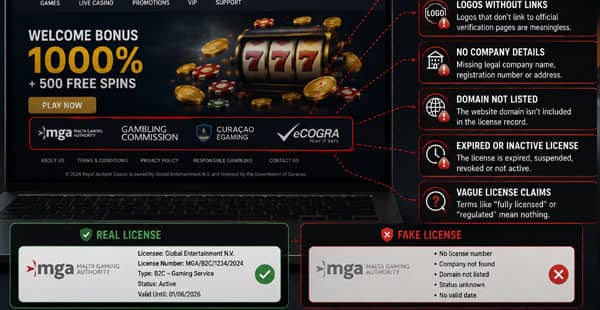
Red Flag 2: Fake or Misleading License Logos
Some scam casinos display regulator logos without permission.
They may show logos from:
- Malta Gaming Authority
- UK Gambling Commission
- Curaçao Gaming Authority
- Isle of Man Gambling Supervision Commission
- Kahnawake Gaming Commission
- eCOGRA
- iTech Labs
- Gaming Labs International
A logo alone does not prove anything.
Scam sites may copy logos from legitimate regulators or testing labs to look trustworthy.
Check whether:
- The logo links to an official verification page
- The license number matches the regulator record
- The legal company name matches
- The domain is listed
- The license status is active
- The regulator actually covers casino gambling
If the logo is only an image and cannot be verified, do not rely on it.
Red Flag 3: Hidden Ownership Information
A trustworthy casino should tell players who operates the site.
Look for the legal company name in:
- Footer
- Terms and conditions
- Privacy policy
- About page
- Responsible gambling page
- License information
- Contact page
A scam casino may hide behind a brand name without naming the company.
This matters because if something goes wrong, you need to know who is legally responsible.
Watch for:
- No company name
- No registered address
- No company registration number
- No named operator
- Only a contact form
- Generic email address
- No regulator record
- Different company names across pages
If the casino does not clearly identify itself, do not deposit.
Red Flag 4: Unrealistic Bonus Offers
Scam casinos often use bonuses to attract deposits.
Common examples:
- 500% welcome bonus
- 1000 free spins
- No-deposit bonus with huge cashout claims
- “Guaranteed winnings”
- “Risk-free casino”
- “Instant withdrawal bonus”
- “No rules bonus”
- VIP bonus after first deposit
- Crypto bonus with no verification ever
A large bonus is not automatically a scam, but unrealistic offers should make you cautious.
The important question is whether the bonus terms are fair and transparent.
Check:
- Wagering requirement
- Max cashout
- Maximum bet
- Restricted games
- Expiry date
- Country restrictions
- Minimum deposit
- Verification rules
- Withdrawal rules
If the casino advertises a huge bonus but hides the terms, that is a serious warning sign.
Casino bonus terms explained.
Red Flag 5: Confusing or Missing Terms and Conditions
A casino’s terms and conditions are where many risks are hidden.
A scam casino may have:
- No terms page
- Very short terms
- Copied terms from another casino
- Contradictory terms
- Vague account closure rules
- Unclear withdrawal rules
- Hidden bonus restrictions
- Broad “irregular play” clauses
- Rules that let the casino void winnings at its discretion
Pay special attention to phrases like:
- “Management decision is final”
- “We may void winnings for any reason”
- “Terms may change without notice”
- “Irregular play may result in confiscation”
- “Bonus abuse is determined at our sole discretion”
Some discretion is normal in gambling terms, but overly broad clauses can be abused.
A trustworthy casino should explain rules clearly enough for players to understand them before depositing.
Red Flag 6: Withdrawal Delays and Payment Complaints
Withdrawal problems are one of the clearest signs of a high-risk casino.
Watch for complaints about:
- Pending withdrawals for weeks
- Repeated document requests
- Support giving different answers
- Approved withdrawals not arriving
- Payment limits not explained earlier
- Accounts locked after a big win
- Winnings removed without clear reason
- Crypto withdrawals marked as paid but not received
- Players forced to reverse withdrawals and keep playing
Some verification delays are normal. Casinos may need to check identity, payment ownership or source of funds.
The problem is when delays become unreasonable, unexplained or selective.
Before depositing, search for payout complaints about the casino. Look for patterns, not isolated cases.
Why casino withdrawals get delayed full guide
Red Flag 7: Suspicious KYC and Verification Practices
KYC means “Know Your Customer.” Licensed casinos often need to verify player identity.
Normal KYC may include:
- ID document
- Proof of address
- Payment method proof
- Bank statement
- Selfie verification
- Source of funds information
KYC is not automatically suspicious.
The red flag is when the casino uses verification unfairly.
Be cautious if:
- KYC requirements are not explained before depositing
- The casino asks for unusual documents without reason
- Documents are repeatedly rejected with no explanation
- Support keeps requesting new documents after every upload
- Verification only becomes difficult after you win
- The casino refuses to give a timeline
- Your account is locked without clear communication
Players should also protect themselves.
Never use fake details, someone else’s payment method or duplicate accounts. Unsafe casinos may use those mistakes as a reason to void withdrawals.
KYC verification rules explained
Red Flag 8: Poor or Fake Customer Support
Customer support is a major trust signal.
Before depositing, test support with simple questions:
- Who licenses this casino?
- What is the withdrawal time?
- Is KYC required before withdrawing?
- Are bonus winnings capped?
- Which countries are restricted?
- How do I file a complaint?
A safe casino should answer clearly.
A scam or high-risk casino may show:
- No live chat
- No email response
- Only chatbot replies
- Generic answers
- Support avoids license questions
- Different agents give different answers
- No complaint escalation process
- Support becomes unavailable after withdrawal requests
If support cannot explain basic licensing, payment and bonus rules, that is a warning sign.
Red Flag 9: Fake Reviews and Reputation Manipulation
Scam casinos often rely on fake reviews.
They may publish their own “top casino” pages, pay for low-quality promotional content or flood forums with positive comments.
Watch for review patterns such as:
- Many 5-star reviews posted within a short time
- Reviews with generic wording
- No details about withdrawals
- No mention of KYC
- No criticism at all
- Copied phrases across different sites
- Review sites that only list bonuses and never mention risks
- No real complaint resolution history
Look for independent signals.
More useful reviews usually mention:
- Withdrawal times
- Document verification
- Support quality
- Bonus disputes
- Account restrictions
- Payment methods
- Complaint outcomes
Do not rely only on star ratings. Read the actual complaints.
Red Flag 10: No Responsible Gambling Tools
A trustworthy casino should provide responsible gambling tools.
These may include:
- Deposit limits
- Loss limits
- Wagering limits
- Session limits
- Reality checks
- Time-outs
- Self-exclusion
- Links to support organizations
- Age verification
- Account closure options
A scam casino may avoid these tools because its goal is to keep players depositing.
Be cautious if:
- Responsible gambling page is missing
- Self-exclusion is hard to find
- Limits cannot be set
- Support pressures players to continue
- VIP offers target losing players
- The casino sends aggressive deposit offers after losses
Player protection is part of trust.
A casino that makes it difficult to stop playing should not be considered safe.
Responsible gambling support resources
Red Flag 11: Country Restrictions Are Hidden
Some casinos accept registrations from countries they should not target.
This creates a serious withdrawal risk.
A casino may let you deposit, but later refuse withdrawal because your country is restricted.
Before signing up, check:
- Restricted countries list
- License coverage
- Terms and conditions
- Bonus eligibility
- Payment method restrictions
- Game provider restrictions
Do not use a VPN to bypass blocks.
If you use a VPN, fake address or incorrect country information, the casino may close your account or void winnings.
A trustworthy casino should block restricted players before deposit, not after they win.
Red Flag 12: Unclear Payment Ownership Rules
Payment ownership rules matter.
Most legitimate casinos require deposits and withdrawals to come from payment methods owned by the registered account holder.
Problems can happen if players use:
- Someone else’s card
- Shared e-wallet
- Business account
- Third-party crypto wallet
- Friend or family member’s bank account
- Mismatched name
- Prepaid card with unclear ownership
Scam casinos may not explain these rules until withdrawal.
Before depositing, check whether the casino requires the payment method to match your account details.
If support cannot explain payment ownership rules, be careful.
Red Flag 13: Copied Website Content or Broken Pages
Many scam casinos are built quickly using copied templates.
Check for signs like:
- Broken links
- Empty policy pages
- Copied terms from another brand
- Brand names that do not match
- Spelling mistakes in legal pages
- Placeholder text
- Fake award badges
- Old copyright dates
- Inconsistent company names
- Missing responsible gambling links
A few mistakes do not automatically prove a scam, but poor legal and payment pages are a serious trust issue.
Casinos that handle real money should have accurate, complete and professional information.
Red Flag 14: Pressure Tactics and Aggressive Promotions
Scam casinos often push players to deposit quickly.
Examples include:
- “Offer expires in 5 minutes”
- “Guaranteed withdrawal today”
- “Deposit now or lose VIP status”
- “Only available if you pay with crypto”
- “Support can unlock a secret bonus”
- “You must deposit again to withdraw”
- “Manager-approved private bonus”
Be careful with any promotion that pressures you to act before reading the terms.
A legitimate casino should let players review bonus rules, payment terms and account requirements before depositing.
Pressure is not a trust signal.
Red Flag 15: No Clear Complaint Process
A safe casino should explain what players can do if something goes wrong.
Look for:
- Customer support contact
- Complaint email
- Complaint timeline
- Escalation process
- Regulator contact
- Alternative dispute resolution body, where applicable
- Terms explaining how disputes are handled
A scam casino may offer only live chat or a generic support form.
If there is no clear way to file a complaint, you may have very limited options if the casino refuses to pay.
How to Check if a Casino Is Legit
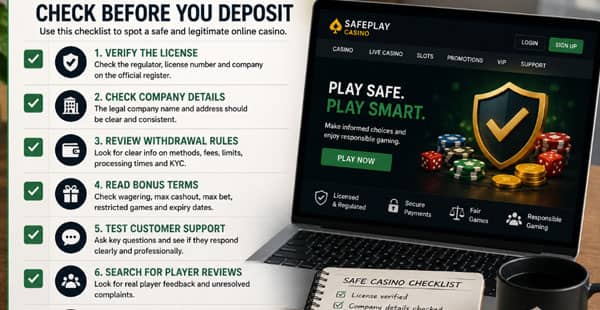
Use this step-by-step checklist before depositing.
1. Verify the License
Find the regulator, license number and legal company name. Then check the regulator’s official register.
Do not trust logos alone.
2. Check the Company Behind the Casino
Make sure the operator is named clearly.
Look for the same company name in the footer, terms, privacy policy and license register.
3. Read Withdrawal Rules
Check payment methods, processing times, limits, fees, KYC requirements and pending periods.
Avoid casinos that do not explain withdrawals clearly.
4. Read Bonus Terms
Check wagering, max cashout, max bet, restricted games and expiry dates.
Do not claim a bonus if the terms are confusing.
5. Search for Complaints
Look for repeated complaints about unpaid winnings, delayed withdrawals, account closures or verification problems.
One complaint may not prove anything. Patterns matter.
6. Test Customer Support
Ask specific questions before depositing.
If support avoids simple questions, that is a warning sign.
7. Check Responsible Gambling Tools
A safe casino should make limits and self-exclusion easy to find.
8. Start Small
If you decide to test a casino, deposit a small amount first.
Do not upload sensitive documents or deposit larger sums until you trust the operator.
Casino.help Scam Casino Checklist
Before depositing, ask these questions:
- Is the casino license real and active?
- Is the legal company name visible?
- Does the domain match the regulator record?
- Are withdrawal rules clear?
- Are bonus terms realistic?
- Are KYC rules explained before deposit?
- Are there many unresolved payout complaints?
- Does support answer licensing and payment questions clearly?
- Are responsible gambling tools easy to find?
- Does the casino hide restricted countries?
- Are payment ownership rules explained?
- Is there a complaint process?
If several answers are negative, avoid the casino.
What to Do If You Already Deposited at a Scam Casino
If you think you deposited at a scam casino, act quickly.
1. Stop Depositing
Do not deposit more money to “unlock” withdrawals, complete fake verification, recover losses or access a promised VIP payout.
Scam casinos may use repeated deposit requests to extract more money.
2. Take Screenshots
Save evidence of:
- Account balance
- Deposit history
- Withdrawal requests
- Bonus terms
- KYC requests
- Chat conversations
- Emails
- License claims
- Transaction IDs
- Error messages
- Blocked account notices
Evidence matters if you need to report the casino.
3. Request a Clear Explanation
Ask support for the exact reason your withdrawal is delayed or refused.
Request links to the specific terms they are using.
4. Do Not Send Unusual Documents Without Thinking
Standard KYC is normal, but be careful if the casino asks for excessive or unusual documents.
If you are unsure, ask why the document is needed and how it will be protected.
5. Contact the Regulator
If the casino claims to be licensed, contact the regulator or use the regulator’s complaint process.
Make sure you are contacting the official regulator website, not a fake link from the casino.
6. Contact Your Payment Provider
If you used a bank card, e-wallet or bank transfer, ask your payment provider what options exist.
Do not make false claims, but explain clearly if the merchant failed to provide the service or refused withdrawal without explanation.
7. Report the Casino
You can report unsafe casinos to relevant regulators, player complaint platforms and consumer protection channels in your country.
How Scam Casinos Use Bonuses to Trap Players
Bonuses are one of the most common tools used by scam or high-risk casinos.
A casino may advertise a large bonus but attach terms that make withdrawal nearly impossible.
Examples include:
- Extremely high wagering requirements
- Low max cashout
- Very short expiry period
- Hidden restricted games
- Maximum bet rules that are easy to break
- Bonus terms changed after signup
- Deposit required before withdrawing no-deposit winnings
- Broad “bonus abuse” clauses
- Country restrictions hidden in separate terms
Players should never judge a bonus by the headline amount alone.
The terms decide whether the bonus has real value.
A smaller bonus with clear terms is often safer than a huge bonus with vague or restrictive rules.
How Scam Casinos Delay Withdrawals
Withdrawal delay tactics can include:
- Repeated KYC requests
- Asking for documents already submitted
- Moving the withdrawal back to pending status
- Claiming “payment provider issues”
- Asking players to cancel and request again
- Saying the finance team is reviewing the account
- Offering a bonus if the player reverses the withdrawal
- Ignoring support messages
- Closing the account after escalation
Some delays are legitimate. Casinos may need to verify identity, payment ownership or source of funds.
But a pattern of vague delays, repeated excuses and no clear timeline is a warning sign.
A trustworthy casino should explain what is needed, why it is needed and how long the process should take.
Are New Casinos More Likely to Be Scams?
Not always.
Some new casinos are legitimate brands operated by established companies.
However, new casinos can carry higher risk because there may be less public history.
Before using a new casino, check:
- Who owns it
- Whether the company runs other brands
- Which license covers it
- Whether the domain is listed by the regulator
- Which payment methods are available
- Whether terms are complete
- Whether responsible gambling tools are active
- Whether early complaints mention withdrawals
If a new casino combines huge bonuses, weak licensing and no ownership transparency, avoid it.
Are Crypto Casinos More Risky?
Crypto casinos can be legitimate, but they require extra caution.
Crypto payments are usually faster, but they are also harder to reverse.
Risks include:
- Anonymous operators
- Weak licensing
- “No KYC” marketing
- Unclear wallet rules
- High bonus restrictions
- Volatile balances
- Irreversible transactions
- Fake crypto payment confirmations
- Country restrictions
A licensed crypto casino may still require identity checks, especially before withdrawals.
Be cautious with any crypto casino that claims players will never need KYC while also claiming to be fully licensed.
Those claims may not fit together.
Are Casino Apps Safer Than Websites?
A casino app is not automatically safer than a casino website.
Some legitimate casinos offer mobile apps, but scam operators can also create apps or fake download pages.
Before installing a casino app, check:
- Whether it is linked from the official casino site
- Whether the operator is licensed
- Whether the app name matches the casino brand
- Whether permissions seem excessive
- Whether payment rules are the same as the website
- Whether app-only bonuses have separate terms
Do not download casino apps from random links, Telegram groups, social media messages or unknown APK sites.
How to Protect Yourself Before Depositing
Use these safer gambling and security habits:
- Verify the license
- Read withdrawal rules
- Read bonus terms
- Search for complaints
- Use accurate personal information
- Deposit small first
- Avoid VPNs unless the casino explicitly allows them
- Use payment methods in your own name
- Keep screenshots of terms and promotions
- Set deposit limits
- Avoid chasing losses
- Do not trust guaranteed win claims
- Do not upload documents to unclear operators
The safest time to check a casino is before you deposit.
After money is already on the site, your options are more limited.
Casino.help Analyst View: What Makes a Casino Safer?
When Casino.help reviews casino safety, we look for signals such as:
- Verifiable licensing
- Transparent ownership
- Clear terms and conditions
- Fair bonus rules
- Realistic withdrawal timelines
- Secure payment methods
- Responsible gambling tools
- Accessible support
- No major unresolved complaint patterns
- Clear KYC process
- Honest marketing
- Consistent information across the site
This connects directly to the Casino.help HELP Rating System:
- Honesty: Are terms clear and transparent?
- Entertainment: Are games reliable and fairly presented?
- Licensing: Is the casino legally licensed and verifiable?
- Payments: Are deposits and withdrawals secure and reliable?
Casino.help HELP Rating System
Responsible Gambling and Scam Prevention
Scam prevention is not only about avoiding bad operators. It is also about protecting yourself from pressure, urgency and risky gambling decisions.
Be careful if a casino or bonus makes you feel rushed.
Stop and reassess if you are:
- Depositing again to recover losses
- Claiming bonuses you do not understand
- Ignoring withdrawal rules
- Feeling pressured by VIP offers
- Gambling longer than planned
- Uploading documents to a site you do not trust
- Continuing because of a “nearly won” feeling
A legitimate casino should make it easy to set limits, take a break or self-exclude.
If gambling stops feeling controlled, use responsible gambling tools or contact a support organization in your country.
Final Verdict: Do Not Deposit Until the Casino Passes Basic Safety Checks
Scam casinos rely on players moving quickly.
They want players to focus on the bonus, the game selection or the promise of fast payouts instead of checking the license, terms, ownership and withdrawal rules.
Before depositing, slow down and verify the basics.
A safe casino should be able to answer simple questions:
Who owns the casino?
Who licenses it?
Is the license active?
Are withdrawals clearly explained?
Are bonus terms realistic?
Can players file complaints?
Are responsible gambling tools available?
If the casino hides the answers, the risk is too high.
The safest decision is often the simplest one: if you cannot verify the casino, do not deposit.
FAQ Section
What is a scam casino?
A scam casino is an online gambling site that misleads players, hides ownership, uses fake or weak licensing, refuses legitimate withdrawals, manipulates terms or operates without meaningful player protection.
How can I tell if a casino is fake?
Check the license, company name, domain, withdrawal rules, bonus terms and complaint history. Red flags include fake license logos, no company details, vague terms, unrealistic bonuses and repeated unpaid withdrawal complaints.
Can a licensed casino still be unsafe?
Yes. A license is an important trust signal, but it does not guarantee that every casino is safe. Some licensed casinos may still have slow withdrawals, poor support, strict bonus rules or unresolved complaints.
What should I check before depositing at an online casino?
Check the regulator, license number, legal company name, exact casino domain, withdrawal rules, KYC process, bonus terms, restricted countries, payment methods, support quality and responsible gambling tools.
Are no-deposit bonuses from unknown casinos safe?
Not always. No-deposit bonuses can be useful for testing a casino, but scam casinos may use them to collect signups or documents. Always check wagering, max cashout, verification rules and the casino license before claiming.
What should I do if a casino refuses to pay?
Stop depositing, save screenshots, collect transaction IDs, keep chat transcripts, ask support for the exact reason, review the terms, contact the regulator if the casino is licensed, and contact your payment provider if needed.
Is it safe to upload ID documents to an online casino?
It can be normal at licensed casinos, but you should only upload ID documents if the casino is properly licensed, transparent about ownership and clear about how documents are used. Avoid sending sensitive documents to unverified sites.
Are crypto casinos more likely to be scams?
Some crypto casinos are legitimate, but crypto gambling can carry extra risks because transactions are usually irreversible and some operators hide behind weak licensing or anonymous ownership. Verify the license and withdrawal rules before depositing.
-

Crimson Castle: A Gothic Slot with Hold & Spin and Collecting Moon Symbols
A blood-red moon hangs over a castle filled with cursed treasures in Crimson Castle, a new 5-reel, 3-row slot with a dark…
Read Complete Article -

Treasure Sparks – Zháo Cái Yán Huó: Features, Bonuses and Free Demo
Fireworks, golden coins and three different Hold & Spin features take centre stage in Treasure Sparks – Zháo Cái Yán Huó. This…
Read Complete Article -

New Game: Henferno with Demo And Bonuses!
A fearless chicken, a path surrounded by fire and one increasingly difficult decision: cash out or keep going? Henferno is a fast-paced…
Read Complete Article -

New Game: Fú Lóng Treasures with Bonuses
Powerful dragons, blazing flames and glittering treasures await in Fú Lóng Treasures, a new 5-reel, 3-row video slot set in a world…
Read Complete Article -

New Slot: Winnie the Piggie Las Vegas with Bonuses
Looking for a new slot with classic casino vibes, quick action, and bonus-packed gameplay? Winnie the Piggie Las Vegas brings the lights,…
Read Complete Article -

New Slot: Triple Tigers with Bonuses!
Triple Tigers has arrived, bringing explosive Wilds, cascading wins and the fierce power of the tiger to every spin. Play Triple Tigers…
Read Complete Article