
How Casino Licenses Work: What Players Need to Check Before Depositing
May 18, 2026
Player Safety Guide
Casino License Safety Guide
A casino license is one of the first trust signals players should check before depositing at an online casino. It shows who regulates the casino, which company operates the site, what rules the operator must follow, and where players may be able to complain if withdrawals, verification or account closures become a problem.

Key Takeaways
- A casino license is formal permission from a gambling regulator that allows an operator to offer real-money casino games legally.
- A license should show which regulator supervises the casino, which legal company owns the brand, and which domains are approved.
- Players should verify the license directly on the regulator’s public register, not only by trusting footer logos or marketing claims.
- Strong regulators usually require identity checks, anti-money laundering controls, responsible gambling tools, fair game testing and complaint procedures.
- An offshore license is not automatically unsafe, but player protection varies heavily by jurisdiction and operator.
- A license helps with accountability, but it does not remove the house edge, prevent all disputes or guarantee that every withdrawal will be approved.
What Is a Casino License?
A casino license is permission from a gambling authority that allows a company to offer real-money gambling products such as online slots, live casino games, table games, poker, sports betting, bingo, lottery products, crypto casino games or other gambling products depending on the country.
For players, the license matters because it connects the casino to a specific legal system. The license should not be treated as decoration. It is part of the casino’s legal accountability.
A licensed casino should show:
- Regulator name
- License number
- Licensed company name
- Registered business address
- Approved casino domains
- License status
- Complaint or dispute process
- Responsible gambling rules
Why this matters:
If a casino cannot clearly explain who licenses it, which company operates it, or where players can verify the license, that is a warning sign. A trustworthy casino should make this information easy to find before players deposit.
Why Casino Licenses Matter for Players
Casino licenses exist to reduce the risk of unfair games, unpaid winnings, money laundering, underage gambling and irresponsible operator behavior. A license does not mean the casino is perfect, but it means the operator is supposed to follow specific rules set by a regulator.
A license can affect:
- Whether the casino can legally accept players from your country
- Whether games must be tested for fairness
- Whether the casino must verify player identity
- Whether funds and transactions are monitored
- Whether responsible gambling tools are required
- Whether complaints can be escalated
Licensing is the first check, not the only check
The strength of licensing rules depends on the jurisdiction. A casino licensed in the United Kingdom, Sweden, Denmark, Ontario or a regulated US state usually operates under stricter local rules than a lightly regulated offshore casino. However, quality can still vary by operator.
Jurisdiction, Regulator and Compliance Explained
Casino licensing often uses three terms that players should understand: jurisdiction, regulator and compliance.
Jurisdiction
The jurisdiction is the country, state, province or territory whose gambling laws apply. Examples include the United Kingdom, Malta, Curaçao, Sweden, Denmark, Ontario, New Jersey, Isle of Man and Kahnawake.
Regulator
The regulator is the authority that supervises gambling operators. Examples include the UK Gambling Commission, Malta Gaming Authority, Curaçao Gaming Authority, Swedish Gambling Authority and New Jersey Division of Gaming Enforcement.
Compliance
Compliance means the casino must continue following the rules after receiving a license. This can include AML checks, age verification, KYC, responsible gambling tools, fair game testing, secure payments and complaint handling.
Ongoing oversight
A license is not supposed to be a one-time badge. A serious regulator expects ongoing compliance, reporting and player protection standards.
How Casinos Get Licensed
Players do not need to understand every legal detail of casino licensing, but it helps to know what a serious licensing process usually checks. Before granting a license, regulators may review company ownership, beneficial owners, source of funds, criminal background checks, financial stability, game software, payment systems, AML policies, responsible gambling procedures, technical security and player complaint procedures.
This matters because a casino that passes meaningful checks is usually safer than one with unclear ownership and no public regulatory oversight. Stronger regulators also supervise operators after approval.
Onshore vs Offshore Casino Licenses
Casino licenses are often described as either onshore or offshore. The difference matters because it can affect player protection, complaint options and legal coverage.
| License Type | What It Means | Player Safety Impact |
|---|---|---|
| Onshore license | A license issued by the country, state or province where the player is located. | Usually stronger local protection, clearer complaint paths and local responsible gambling standards. |
| Offshore license | A license issued in one jurisdiction while accepting players from other countries. | Not automatically unsafe, but protection varies more and players should verify the operator carefully. |
Offshore play can reduce player protection if the casino is not locally licensed in your country. Risks may include weaker complaint options, payment restrictions, harder enforcement and terms that favor the operator.
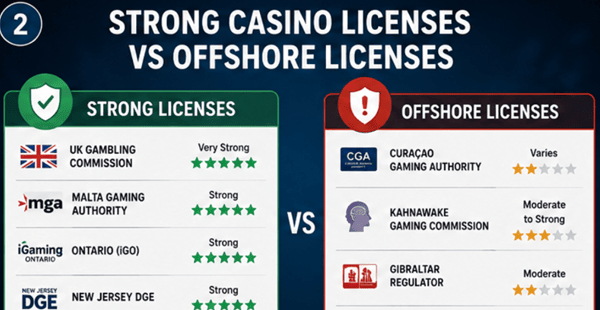
Which Casino Licenses Are Usually Stronger?
There is no perfect global ranking of casino licenses, but some regulators are generally considered stronger because they require stricter compliance, clearer player protections and more visible enforcement.
Examples of stronger or more established regulatory markets include the United Kingdom, Malta, Sweden, Denmark, Ontario, regulated US states such as New Jersey, Pennsylvania and Michigan, and the Isle of Man.
Offshore jurisdictions can vary more. For players, the practical lesson is simple: do not judge a license only by the logo. Check the regulator, the company, the license status and the registered domain.
How to Verify an Online Casino License
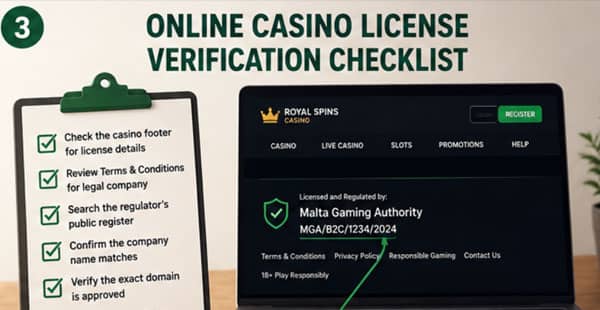
Checking a casino license usually takes only a few minutes. Use this process before depositing.
Step-by-Step Guide
Follow these steps to complete the process.
- Check the casino footer
Scroll to the bottom of the casino website and look for the regulator name, license number, legal company name, registered address, responsible gambling links, terms and complaint procedure.
- Check the terms and conditions
Open the casino terms and look for the licensed company name, governing law, restricted countries, withdrawal rules, KYC rules, bonus terms and complaint procedure.
- Search the regulator’s public register
Go to the regulator’s official website and search by casino brand, company name, license number, website URL or domain name.
- Check the exact domain
Some casino groups own multiple brands. Make sure the exact casino domain you are using is listed or clearly connected to the licensed operator.
- Check license status
Look for whether the license is active, suspended, revoked, expired, pending, surrendered or inactive. Do not rely on a license number if the license is no longer active.
- Check for regulatory actions
Some regulators publish enforcement actions or penalties. A past action does not always mean a casino is unsafe today, but repeated enforcement issues can signal weak compliance.
Casino.help Player License Checklist
Before depositing at an online casino, check the following
- Does the casino clearly name its regulator?
- Is the license number visible?
- Is the legal company name shown?
- Does the company match the regulator register?
- Is the exact casino domain listed or connected to the license?
- Is the license active?
- Are withdrawal rules easy to find?
- Are KYC requirements explained clearly?
- Are bonus terms transparent?
- Does the casino offer responsible gambling tools?
- Is there a clear complaint process?
- Are there unresolved withdrawal complaints?
If several of these are missing, treat the casino as higher risk.
Red Flags in Casino Licensing Information
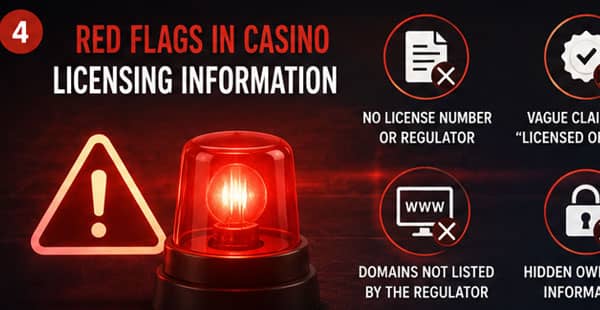
A casino license should be easy to verify. Watch for these red flags:
Warning Signs
Watch for these warning signs before continuing.
- No regulator named
- No license number
- Vague phrases like “licensed offshore”
- Fake regulator logos
- Logos that do not link to official records
- Expired or suspended license
- Company name mismatch
- Domain not listed by the regulator
- No terms and conditions page
- No responsible gambling information
- No complaint process
- Support refuses to explain licensing details
What a Casino License Protects You From
A strong casino license can improve player protection in several ways. It may help protect against completely unregulated operators, rigged or untested games, unfair refusal to pay legitimate winnings, misleading advertising, missing responsible gambling controls, weak AML checks, poor complaint handling, hidden ownership and unsafe payment practices.
It may also give players a place to escalate complaints. Stronger regulators may require licensed casinos to follow formal complaint procedures or use approved dispute resolution bodies. This does not mean every complaint will succeed, but it creates a more structured process.
What a Casino License Does Not Protect You From
A casino license has limits. It does not protect you from losing money to the house edge, poor bankroll management, chasing losses, breaking bonus terms, failing KYC checks, using false account details, playing from a restricted country, using a VPN against the rules, opening multiple accounts or all possible disputes.
Winnings may be delayed or refused if identity documents are not approved, the payment method does not match the account holder, the player used a restricted country, exceeded bonus max bet limits, created duplicate accounts or violated anti-fraud checks.
Casino Licenses and Withdrawals
Licensing matters most when real money is involved. A trustworthy casino should explain minimum and maximum withdrawal amounts, payment methods, processing times, KYC requirements, withdrawal fees, pending periods, country restrictions, bonus-related withdrawal limits and source of funds checks.
A licensed casino is usually expected to follow its stated withdrawal rules. But players must also follow the casino’s terms. A license is useful, but clear payment terms are just as important.
Casino Licenses and Bonus Terms
A casino license can help reduce misleading promotions, but it does not make every bonus player-friendly. Licensed casinos may still offer bonuses with wagering requirements, max cashout limits, restricted games, max bet rules, expiry dates, country restrictions and verification requirements.
Players should read bonus terms before claiming any offer. A license does not override the bonus rules. If you break the terms, a casino may void bonus winnings even if it is licensed.
Casino Licenses and KYC Verification
KYC means “Know Your Customer.” Licensed casinos often must verify player identity to prevent underage gambling, fraud, money laundering and restricted-country play. This may include passport or ID, proof of address, payment proof, bank statements, selfie verification or source of funds information.
Some players see KYC as a problem, but in regulated markets it is usually part of compliance. The real issue is transparency. A safe casino should explain when KYC is required, which documents may be requested, how long verification usually takes, whether withdrawals are blocked during review and how player data is protected.
Are Offshore Casinos Legal?
This depends on the player’s location and the operator’s license. Some countries allow online gambling only through locally licensed operators. Some tolerate offshore casinos. Others prohibit or restrict online gambling entirely.
In many markets, enforcement focuses more on operators, payment providers and advertising than individual players. But that does not mean offshore play is risk-free. Possible issues include reduced consumer protection, no local complaint process, payment blocks, domain blocking, tax uncertainty, no access to national self-exclusion tools and harder recovery if funds are withheld.
If a casino is not allowed to accept players from your country, using a VPN can violate the casino’s terms and put withdrawals at risk.
Why Some Casinos Block Certain Countries
Country restrictions are common in online gambling. A casino may block players from certain countries because of local gambling laws, license restrictions, payment processor rules, game provider restrictions, tax rules, responsible gambling requirements or regulator instructions.
If you see “not available in your jurisdiction,” that does not automatically mean the casino is unsafe. It may mean the operator is following licensing rules. But if a casino claims to accept everyone, asks players to use a VPN, or avoids explaining restricted countries, that is a red flag.
Digital Casino Licenses and Crypto Casino Licenses
A digital casino license usually refers to a license for remote gambling: online casino websites, mobile apps or live dealer platforms. A crypto casino license is usually not a completely separate category. In most cases, it is a remote gambling license from a regulator that allows the operator to accept cryptocurrency.
Crypto casinos may accept Bitcoin, Ethereum, Litecoin, USDT, USDC, Dogecoin or other digital assets. But licensed crypto casinos may still need to follow KYC rules, AML monitoring, age verification, fair game testing, responsible gambling rules, country restrictions and withdrawal limits.
Be careful with crypto casinos that advertise “no rules,” “no KYC ever” or “anonymous gambling” while also claiming to be fully licensed. Those claims can conflict with how regulated gambling usually works.
How to Judge a Casino License in Practice
Do not treat licensing as a simple yes or no. Instead, ask how useful the license is for the player.
Use safer gambling habits
- Set a deposit limit
- Set a loss limit
- Avoid chasing losses
- Do not gamble with borrowed money
- Take breaks
- Use self-exclusion if needed
- Read bonus terms before claiming offers
- Stop if gambling no longer feels controlled
Final Verdict: Always Verify the License Before You Play
A casino license is one of the most important checks players can make before depositing. It helps answer basic safety questions: Who operates this casino? Which regulator supervises it? Is the license active? Is this exact domain approved? Are payment and verification rules clear? Can players escalate complaints?
If the answer is unclear, do not deposit until you verify the details. A trustworthy casino should not make licensing difficult to understand.
The safest approach is simple: check the license, read the terms, understand the withdrawal rules, and avoid casinos that hide basic information about who regulates them.
Frequently Asked Questions
What is a casino license?
A casino license is permission from a gambling regulator that allows an operator to offer real-money casino games legally. It should identify the regulator, licensed company, approved domains and rules the casino must follow.
Why does a casino license matter?
A casino license matters because it gives players a way to judge whether the casino is regulated, accountable and legally supervised. It can improve protection around withdrawals, fair games, complaints, KYC checks and responsible gambling tools.
How do I check if an online casino license is real?
Look for the regulator name, license number and legal company name in the casino footer or terms. Then search the regulator’s official public register and confirm that the company, license status and casino domain match.
What are red flags in casino licensing information?
Red flags include missing license numbers, vague claims like “licensed offshore,” fake regulator logos, expired license status, mismatched company names, hidden ownership and domains not listed on the regulator’s register.
Is an offshore casino license safe?
An offshore license is not automatically unsafe, but protection varies by jurisdiction and operator. Players should verify the license, check the domain, read withdrawal rules and look for unresolved payout complaints.
Does a license guarantee my winnings?
No. A license improves player protection and may provide a complaint process, but it does not guarantee every withdrawal. Casinos can reject withdrawals if players breach KYC, bonus, payment, account or country rules.
Can a licensed casino still delay withdrawals?
Yes. Licensed casinos may delay withdrawals for KYC checks, payment verification, source of funds checks, bonus disputes or fraud reviews. The important question is whether the delay follows clear, published rules.
Are crypto casino licenses different?
Usually not. A crypto casino license is normally a remote gambling license that permits cryptocurrency payments. Licensed crypto casinos may still need to follow KYC, AML, age verification and responsible gambling rules.
-

Crimson Castle: A Gothic Slot with Hold & Spin and Collecting Moon Symbols
A blood-red moon hangs over a castle filled with cursed treasures in Crimson Castle, a new 5-reel, 3-row slot with a dark…
Read Complete Article -

Treasure Sparks – Zháo Cái Yán Huó: Features, Bonuses and Free Demo
Fireworks, golden coins and three different Hold & Spin features take centre stage in Treasure Sparks – Zháo Cái Yán Huó. This…
Read Complete Article -

New Game: Henferno with Demo And Bonuses!
A fearless chicken, a path surrounded by fire and one increasingly difficult decision: cash out or keep going? Henferno is a fast-paced…
Read Complete Article -

New Game: Fú Lóng Treasures with Bonuses
Powerful dragons, blazing flames and glittering treasures await in Fú Lóng Treasures, a new 5-reel, 3-row video slot set in a world…
Read Complete Article -

New Slot: Winnie the Piggie Las Vegas with Bonuses
Looking for a new slot with classic casino vibes, quick action, and bonus-packed gameplay? Winnie the Piggie Las Vegas brings the lights,…
Read Complete Article -

New Slot: Triple Tigers with Bonuses!
Triple Tigers has arrived, bringing explosive Wilds, cascading wins and the fierce power of the tiger to every spin. Play Triple Tigers…
Read Complete Article